
Emma’s Story
Teaching and Educational Innovation
Emma began her career in communications and multimedia, working at Prime Television in Watson (now Channel 9). At just 23, she realised she was only two promotions away from the highest possible position there. After falling in love with Canberra and choosing to stay, she pivoted to education, earning her degree in primary school education.
In 2018, Emma worked at Radford College to address a critical gap in teenage mental health support. Together with Claire Melloy they identified that teenagers with mental health needs had limited access to support services, while those with more serious needs were already seeing specialists.
For the vast majority in between, nothing existed. Emma co-wrote Australia’s first curriculum linking teenagers with charity work, creating a vertically integrated program where students of different ages collaborated with 38 different charities. The theory proved correct – by engaging in volunteering and giving to others, students showed improved mental health outcomes. This innovative program continues in some form in schools today.
During the challenging 2020 COVID lockdowns, with her three young primary-school-aged children learning from home, Emma helped other teachers navigate online learning platforms and technology, all while supporting her middle child through his diagnosis of dyspraxia.
Transforming Lids4Kids
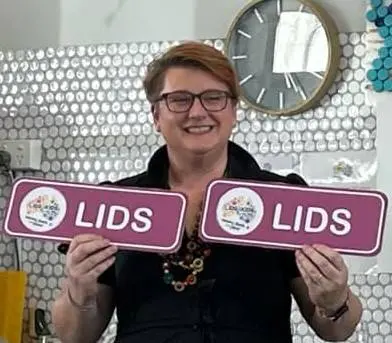
Emma’s trajectory changed dramatically in 2021 when her Year 4 class participated in Lids4Kids, a plastic lid recycling initiative. What started as a class project became a whole-school movement, with students collecting over 400 kilograms of lids—more than any other school in Australia in that time. Tim Miller, founder of Lids4Kids and ACT Australian of the Year, subsequently invited Emma as his guest to the Australian of the Year Awards.
It was here that Emma fell in love with the not-for-profit sector. She initially volunteered as Executive Assistant to help get Lids4Kids back on its feet. Within six weeks, she became CEO.
Over the next three years, Emma completely transformed Lids4Kids by:
- Increasing revenue by 1800%
- Delivering the 3-year strategic plan in 2.5 years, and the 5-year plan in 3 years.
- Establishing Canberra’s only micro plastic recycling centre and community education hub.
- Building governance structures, including a new Board, insurance, banking systems, and volunteer safety protocols,
- Growing the volunteer network to over 300 volunteers monthly.
- Serving 55,000 people across the ACT.
- Diverting 304 tonnes of plastic from landfill.
- Providing educational sessions to approximately 4,000 students.
- Delivering social training programs for 1,500 disabled adults.
- Creating Australia’s most sustainable subscription packaging service for postal services.
- Establishing small parts recycling programs in 3,000-4,000 Canberra homes.
- Developing partnerships with University of Tasmania engineering department students to create 3D printer filament from recycled lids, aiming to produce free prosthetic limbs for disabled children.
- Emma also brought innovation to unexpected places, introducing lid sorting as mindful work in ACT detention centres, where inmates engaged enthusiastically in the program.
Her work with Lids4Kids earned recognition through keynote speaking opportunities at IMB Bank Community Foundation Awards and extensive engagement with the local charity sector through organisations like Hands Across Canberra.
AI Training for the Not-for-Profit Sector
Running Lids4Kids solo on a laptop, Emma was forced to find solutions to overwhelming workloads. Her husband, who works in international tech security, had shown her ChatGPT in late 2021, but Emma didn’t revisit it until she was drowning in work a year later. Following advice to “pick one problem and solve it,” she began using AI to draft emails from prompts.
Through self-directed learning on YouTube and experimentation throughout 2023-24, Emma mastered prompting techniques and expanded her use of AI to draft agreements, MOUs, grant applications, and brainstorming—using it as a powerful editing and research tool.
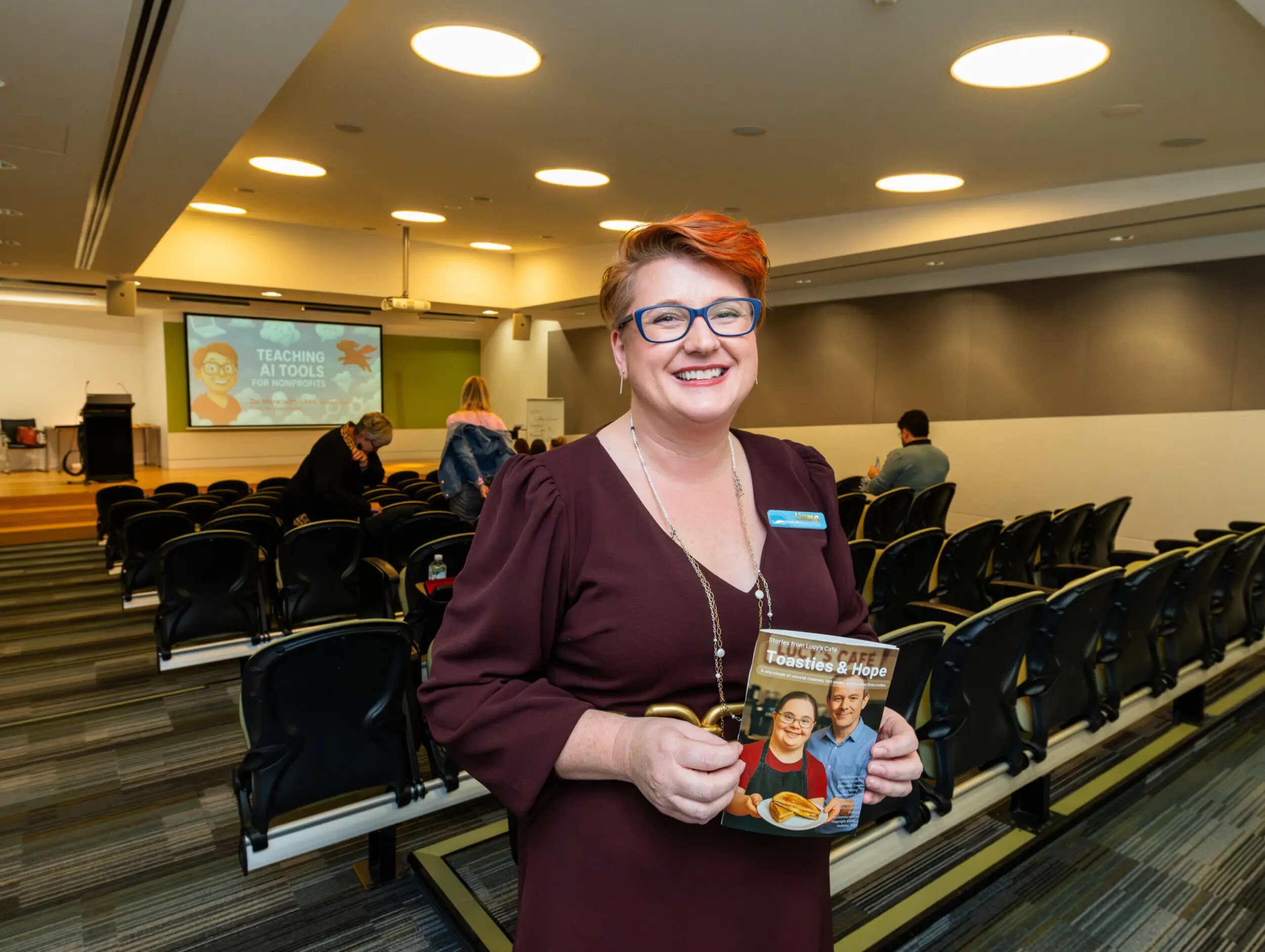
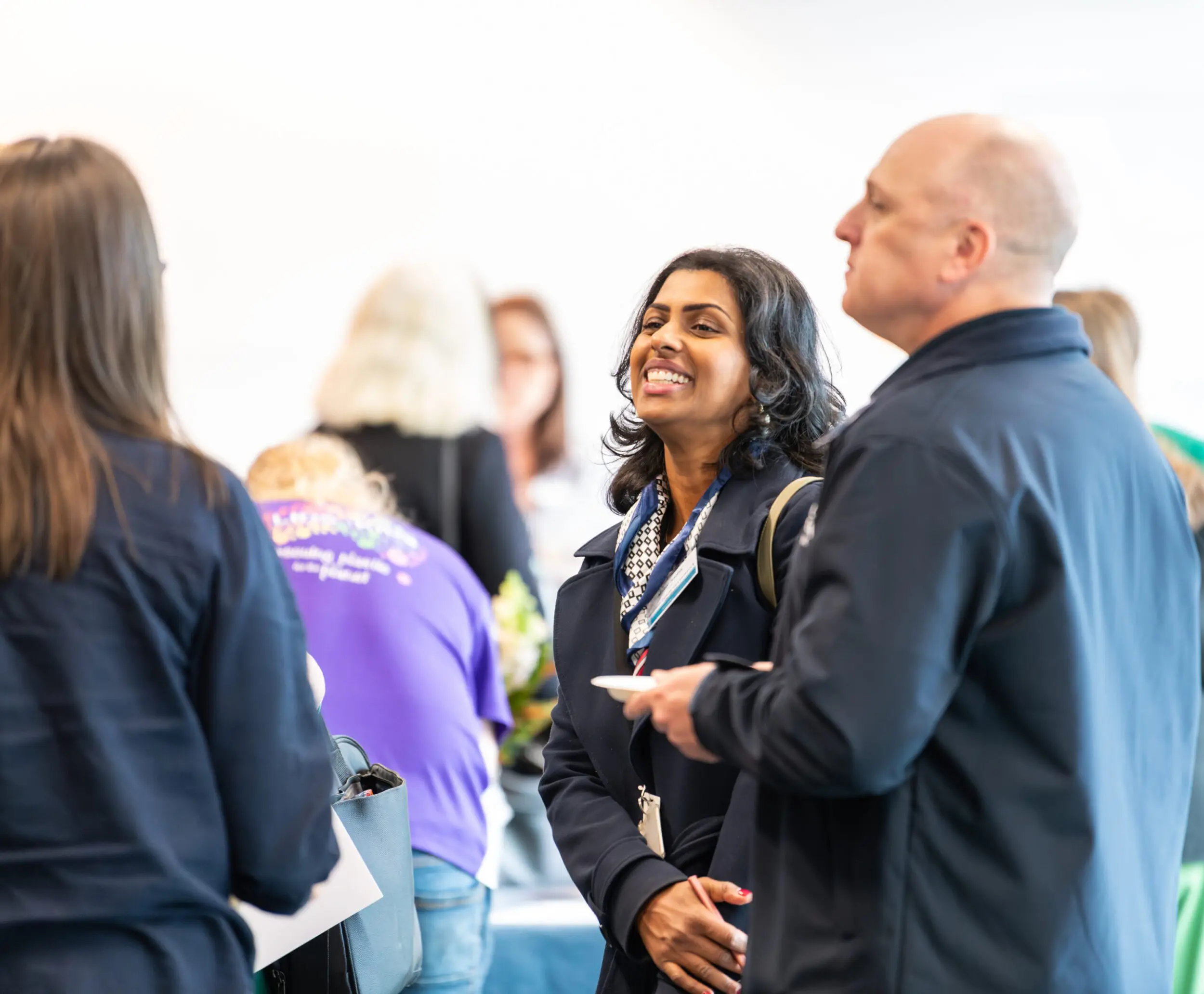
Recognising that not-for-profits are often under-resourced and under-tooled, Emma shifted to training others. In 2025 alone, she as trained nearly 80 charity leaders and department heads across the ACT in AI tools and applications, supported by organisations including the Canberra Collective, Hands Across Canberra, and Marymead.
Emma is an early adopter with a unique combination of technical knowledge (translated from “IT speak”), teaching expertise, and deep understanding of the not-for-profit sector. Her mission is to “lift the water for all the boats”—helping the entire not-for-profit sector access AI tools and systems, rather than just one or two organisations.

Creative Pursuits and Community Leadership
Although self-taught, Emma is an expert level cake decorator, previously a professional and US competitor, now a committed hobbyist enjoying the art for ‘arts sake’.
Emma has recently ‘accepted the pink spatula’ and is now leading the Australian Cake Decorating Network (ACDN) where her community expertise and business acumen will be used to strengthen and grow the sector. Her ability to support and scale up communities of practice will ensure better outcomes for both hobbists and professionals in the cake sector as individuals and as a whole.
Never one to sit still, she also enjoys sewing, cabinet making, home renovating, paper craft and stamping and is currently restoring a 120-year file and mail sorting sideboard in the evenings. These aren’t just pastimes; they are essential to her mental health and creative problem solving skills.
Background and early life
Born and raised in Canberra, Emma has deep roots in the nation’s capital. She met her husband at university, where she was President of the Outdoor Club. Their shared love of adventure—bonding over abseiling and caving at Wee Jasper—would shape their life together. The couple have now been married for over 20 years.
Emma’s early involvement with the Duke of Edinburgh’s Award exposed her to volunteering and community service, sparking a lifelong passion for giving back. She earned all three Duke of Edinburgh awards, became an international leader, and attended a conference in Canada in 2002. These experiences, combined with 15 years of playing and coaching hockey, developed her leadership skills and deep empathy for others.
Always one to spot opportunities, Emma and her husband purchased land in Gungahlin before it was the thriving community that it is today. This ability to see potential and build upon it for the future has remained a hallmark of Emma’s approach to life and work.
In 2008, just six months after Emma started teaching her first class of Year 2 students, her husband received an opportunity with Microsoft that would take them to Seattle. Emma put her career on hold to support the move, spending nearly four years in the Pacific Northwest. While her husband’s career flourished, Emma’s was disrupted. She turned this challenge into opportunity, discovering a love of cake decorating and opening a wedding cake business while subcontracting in a cake studio. The US cake industry was years ahead of Australia at the time, and Emma absorbed cutting-edge techniques and community practices that would inform her work for years to come.
The couple returned to Canberra with their first child at just 12 weeks old, eventually welcoming three boys into their family.
Take 5 with Emma A Holliday
What’s something you’ve taken with you from each of your different roles?
From Lids4Kids, I learned to stay humble and gained crucial business acumen. Managing volunteers taught me just how complicated people management can be—and building leadership skills and confidence in others.
As a new leader, I got knocked on my backside a few times, and those lessons in humility stay with me.
The Duke of Edinburgh’s Award taught me leadership and public speaking, shaping how I show up in public spaces.
Teaching gave me the ability to deliver information in multi-faceted ways and truly appreciate diverse perspectives. It taught me how to meet people where they are.
Parenting a neurodiverse family has deepened my empathy beyond measure. My middle son’s journey to diagnosis taught me the power of acceptance—the moment in “The 7 Habits of Highly Effective People” where Stephen Covey talks about letting go once you truly understand a situation. It’s about seeing and valuing people for who they are.
Volunteering taught me to analytically understand the value of giving—it’s not just feel-good rhetoric. The best thing you can do in life is give to others. The mental health benefits are real and measurable.
My work with recycling and ethical consumerism has given me a deep understanding of systems and processes, helping me see how small actions create large-scale change.
What really excites you?
I’m fascinated by the emerging field of online communities and how collaboration has shifted since COVID. We’ve moved into multi-modal learning and multi-platform “tech stacks,” which can feel overwhelming—but there’s so much potential here.
The shift away from social media-dominated spaces toward more intentional, less distracting, and more efficient ways of working together excites me enormously. Tech platforms have the ability to change moods and communities. When we get this right, we can fundamentally improve how people connect and collaborate.
I’m also excited about helping the cake decorating community modernise and adapt. I’ve walked in their shoes—as a professional bakery owner, an expert decorator, and a home baker with kids at my feet. I understand the challenges, and I want to help the community navigate disruptions in the industry.
What’s your ‘why’? Why do you do what you do each day?
My entire purpose is to help others achieve their outcomes. When I come into a space, I want to leave it better than I found it—with new perspectives, better systems, and humans who feel valued and supported.
I believe deeply in the power of volunteering and giving back.
There are huge mental health benefits to helping others, and I’ve seen this proven again and again—in research, in the teenagers I worked with, in my own life.
I also have a passion for valuing people, especially those who feel demoralised or undervalued. Too many people in the not-for-profit sector feel this way, and I want to change that. Everyone deserves to feel their work matters.
What’s your favourite motto to live by?
“Everything is work-outable.”
You can work through anything. There’s always a solution, always a way forward. Sometimes you just need to pick one problem and solve it, then move to the next. This motto has carried me through career disruptions, cross-continental moves, COVID teaching with three kids at home, building organisations from scratch—everything.
What’s your advice to people just starting out?
Pick one problem and solve it. Don’t try to do everything at once.
Value people. Really see them. Create environments where people feel appreciated for who they are and what they bring.
Don’t be afraid to try new things. I’ve been a film editor, teacher, cake decorator, CEO, AI trainer, and more. Your diverse experiences aren’t a weakness—they’re your unique strength.
Embrace technology, especially AI. It’s not as scary as it seems. Start small—maybe just drafting emails—and build from there. For not-for-profits especially, these tools can be life-changing when you’re under-resourced.
Give back. Volunteer. Get involved in your community. The benefits come back to you in ways you can’t imagine—and you’ll make a real difference in the world.
And remember: when people say “where have you been all my life?” or “you’re a breath of fresh air,” you’re on the right track. Keep showing up authentically, bringing new perspectives, and helping others achieve their outcomes.
Get in touch with Emma A Holliday
Whether you’re a not-for-profit drowning in admin work, a corporate team exploring AI training, or an individual ready to learn, let’s work out what makes sense for you.